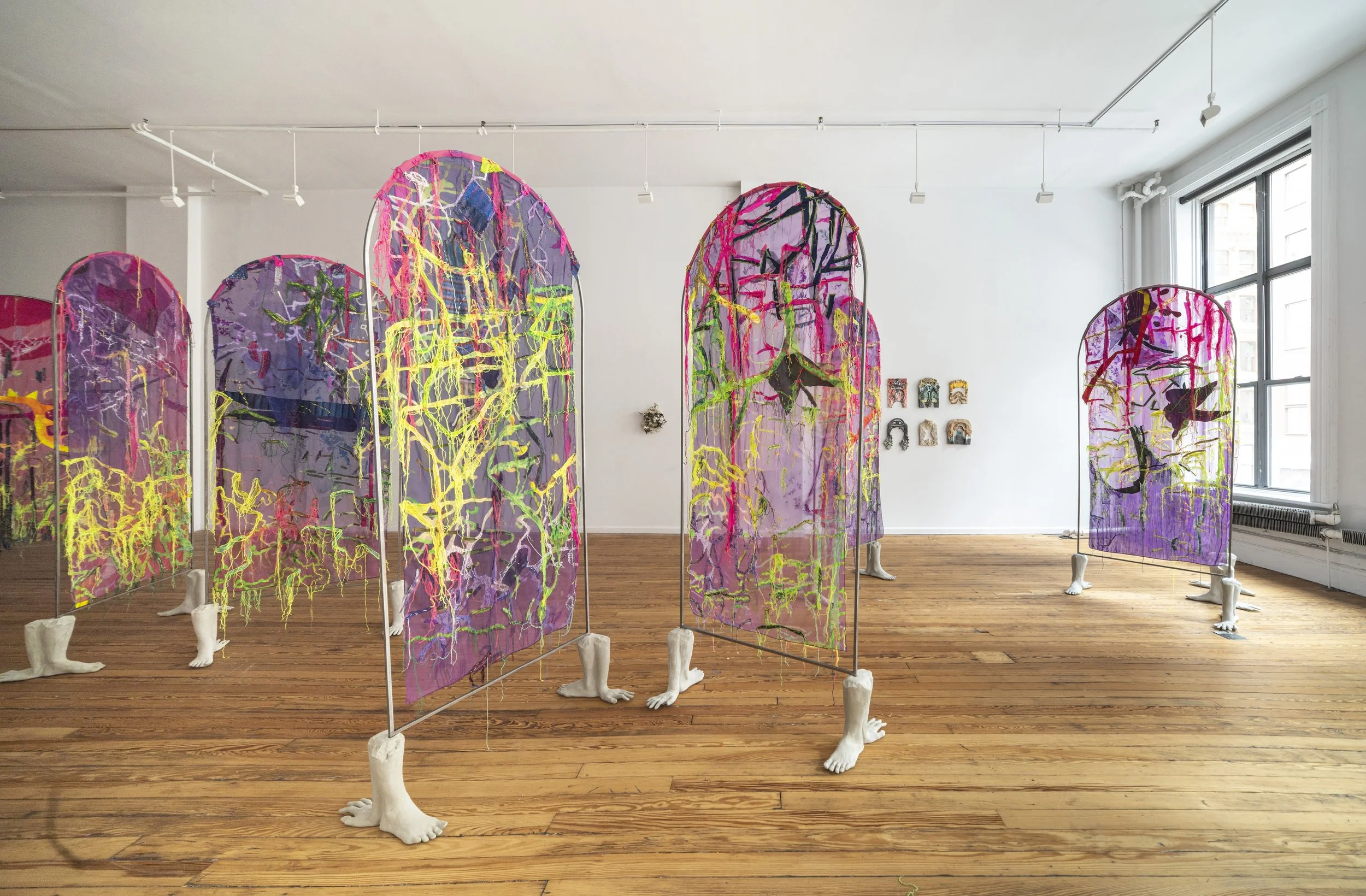
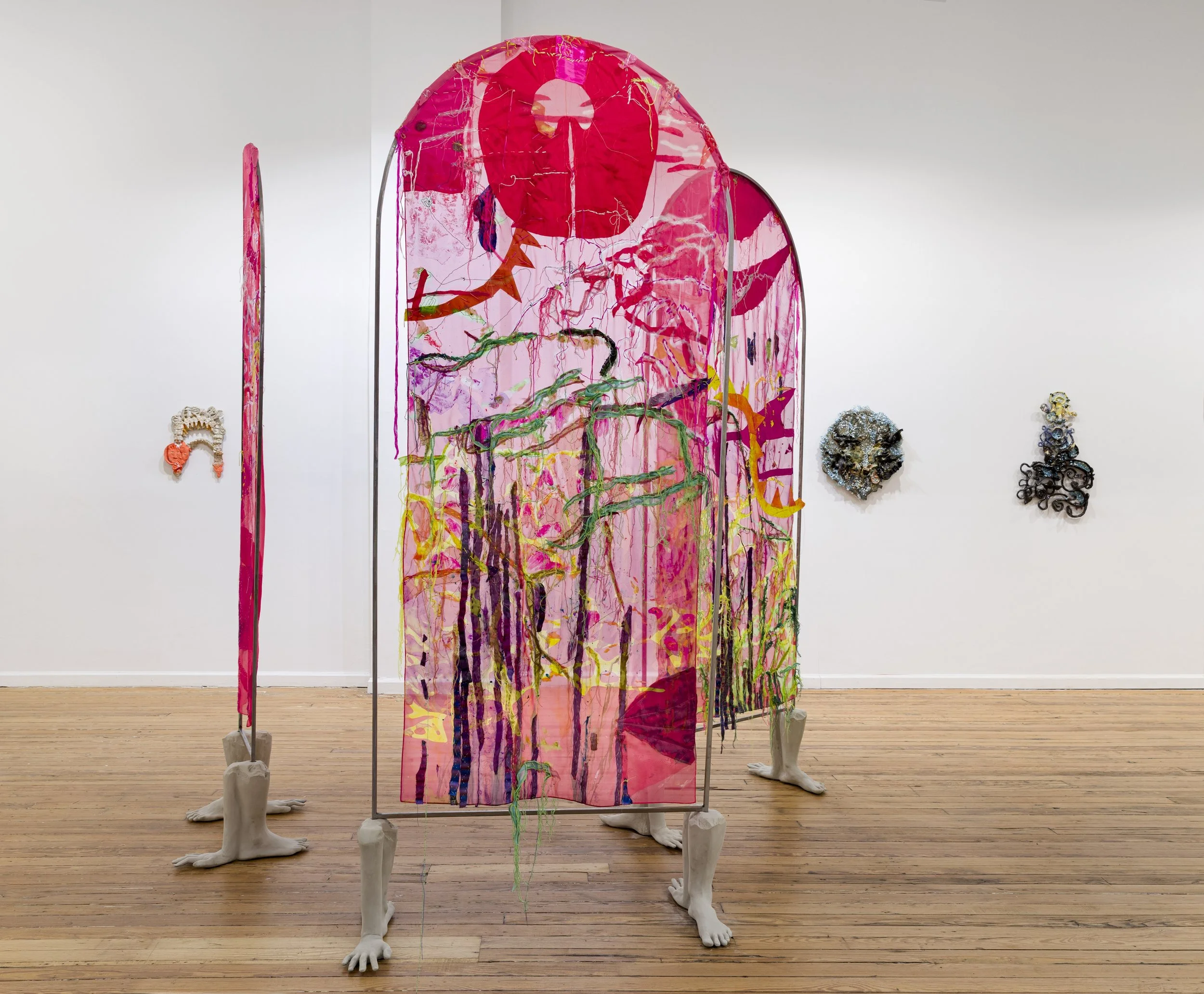

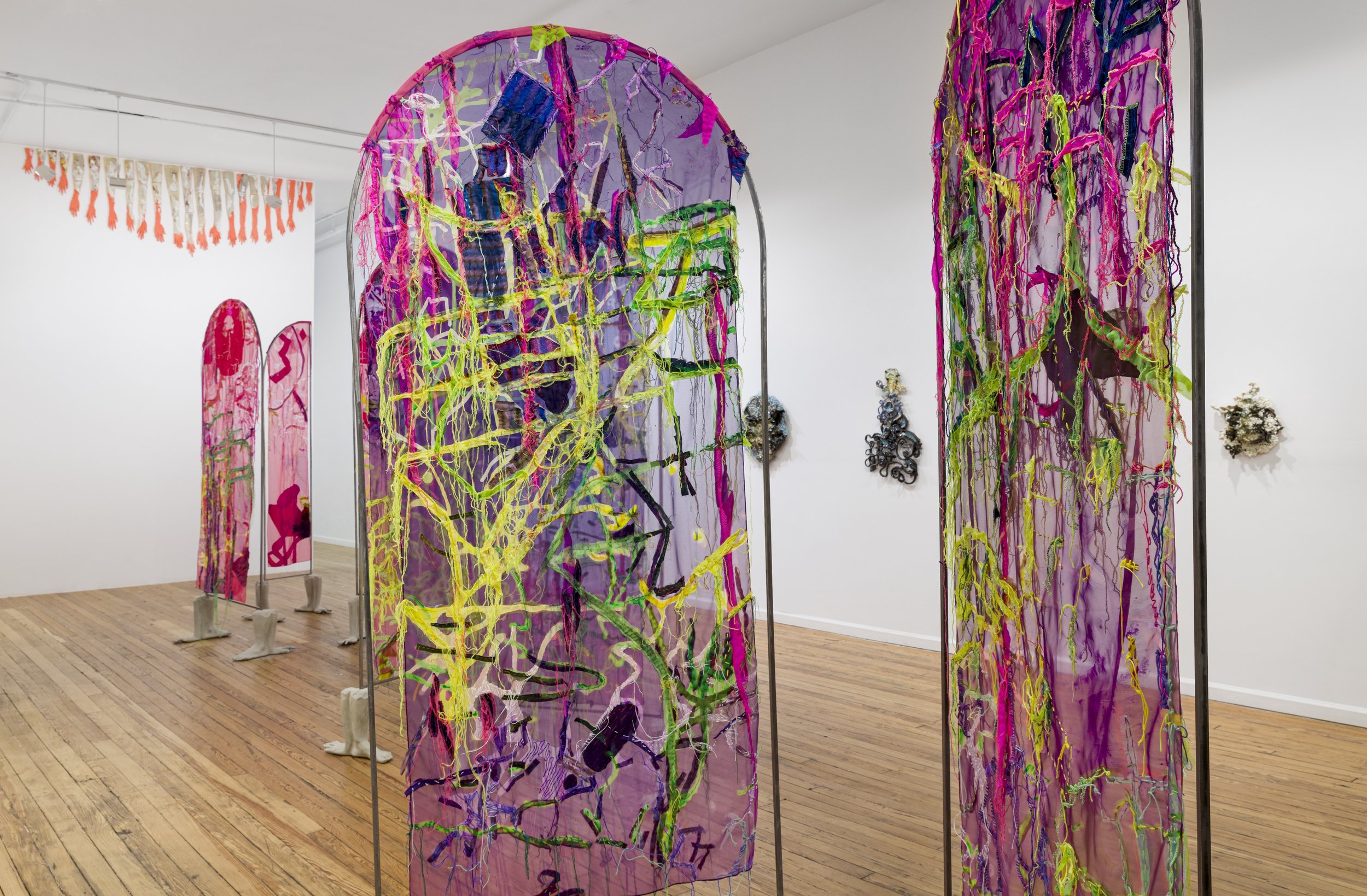
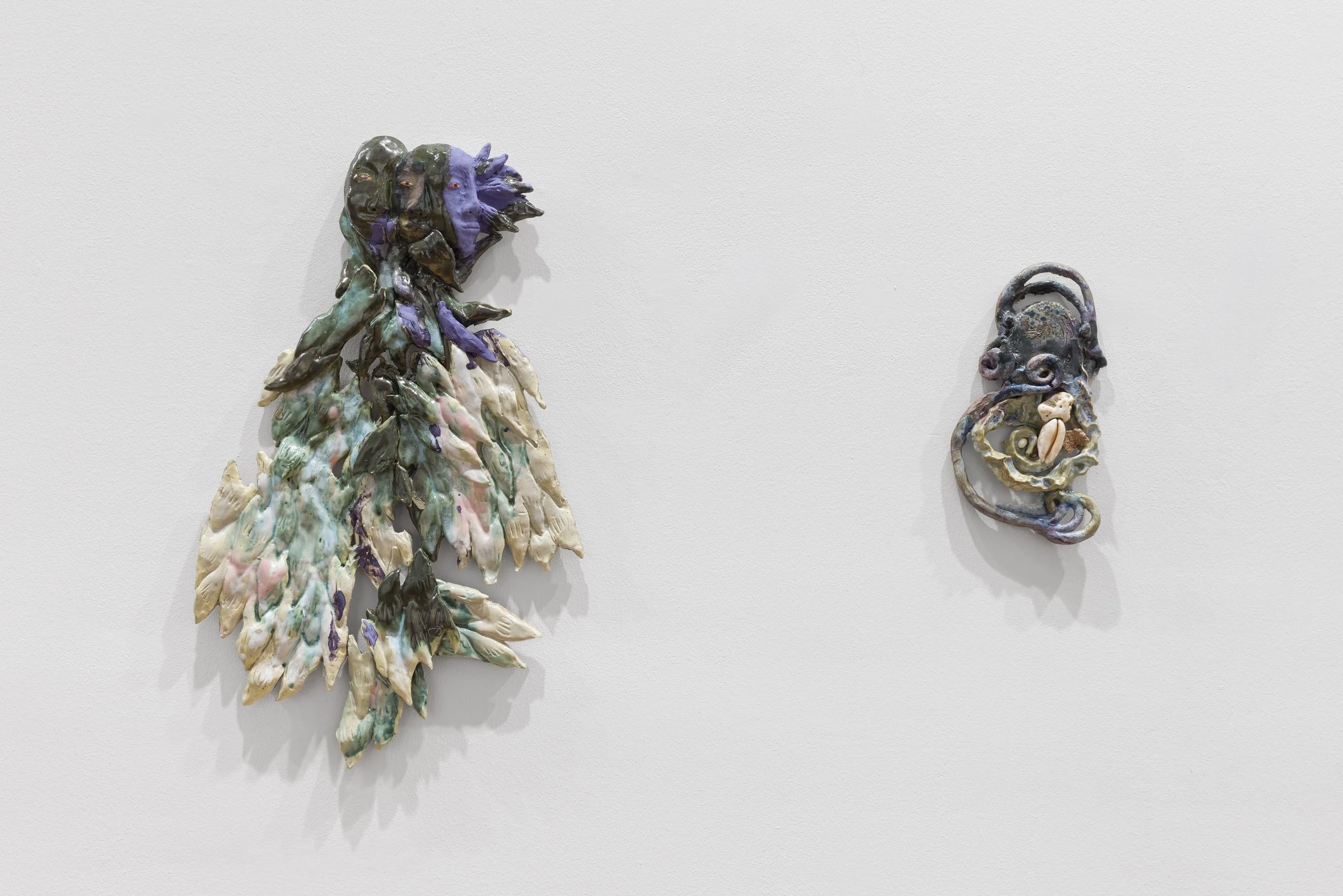
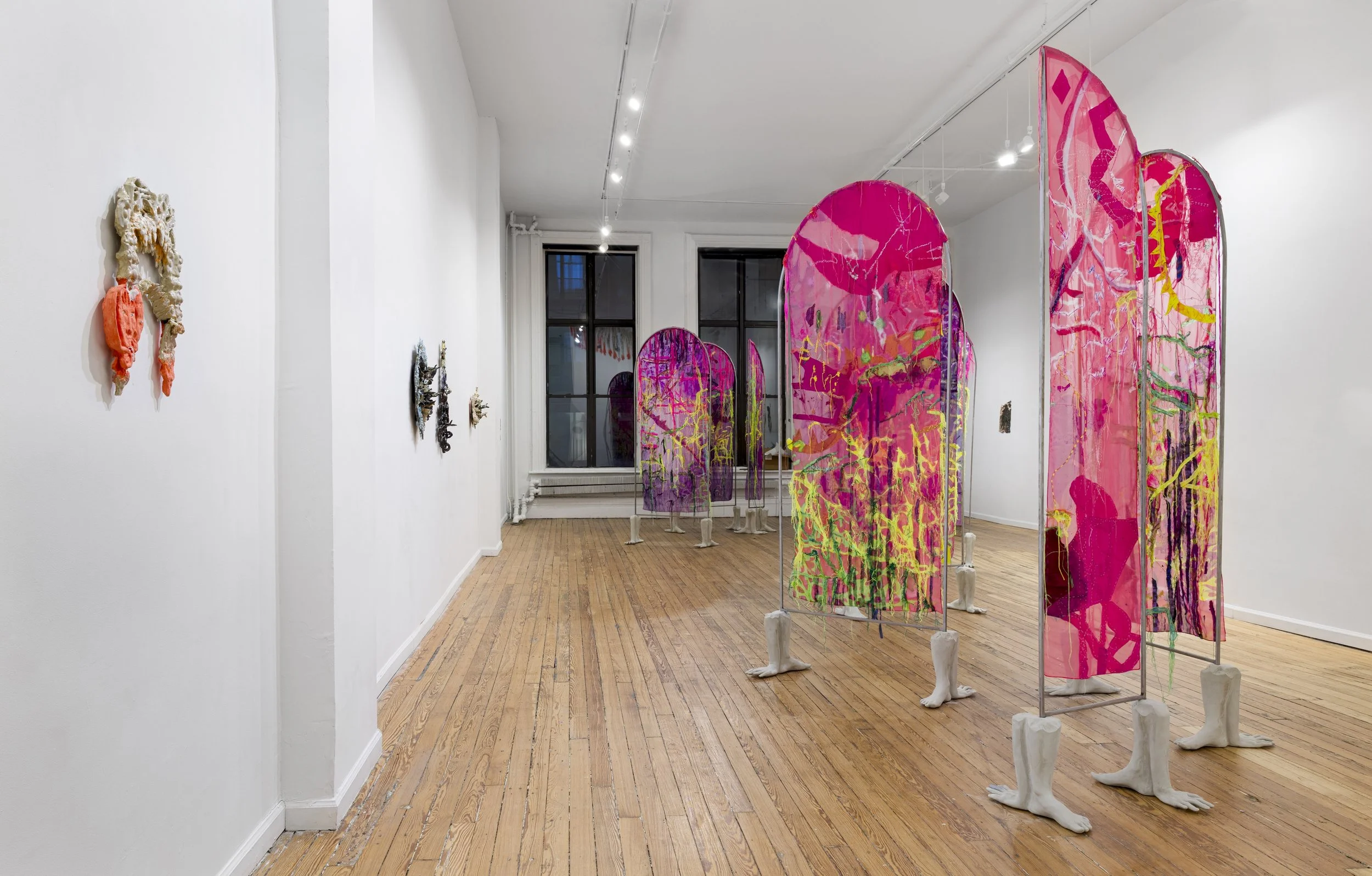
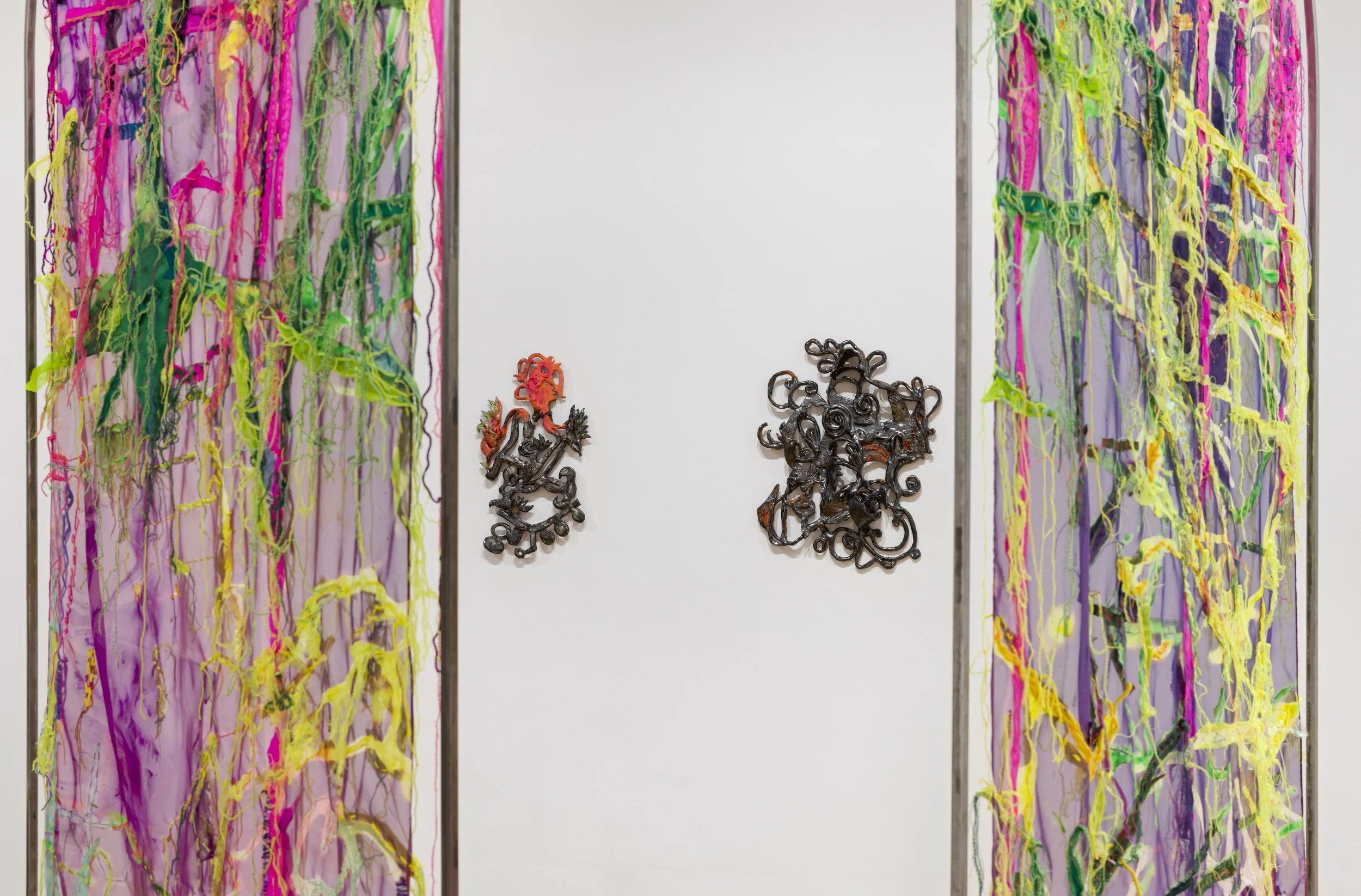
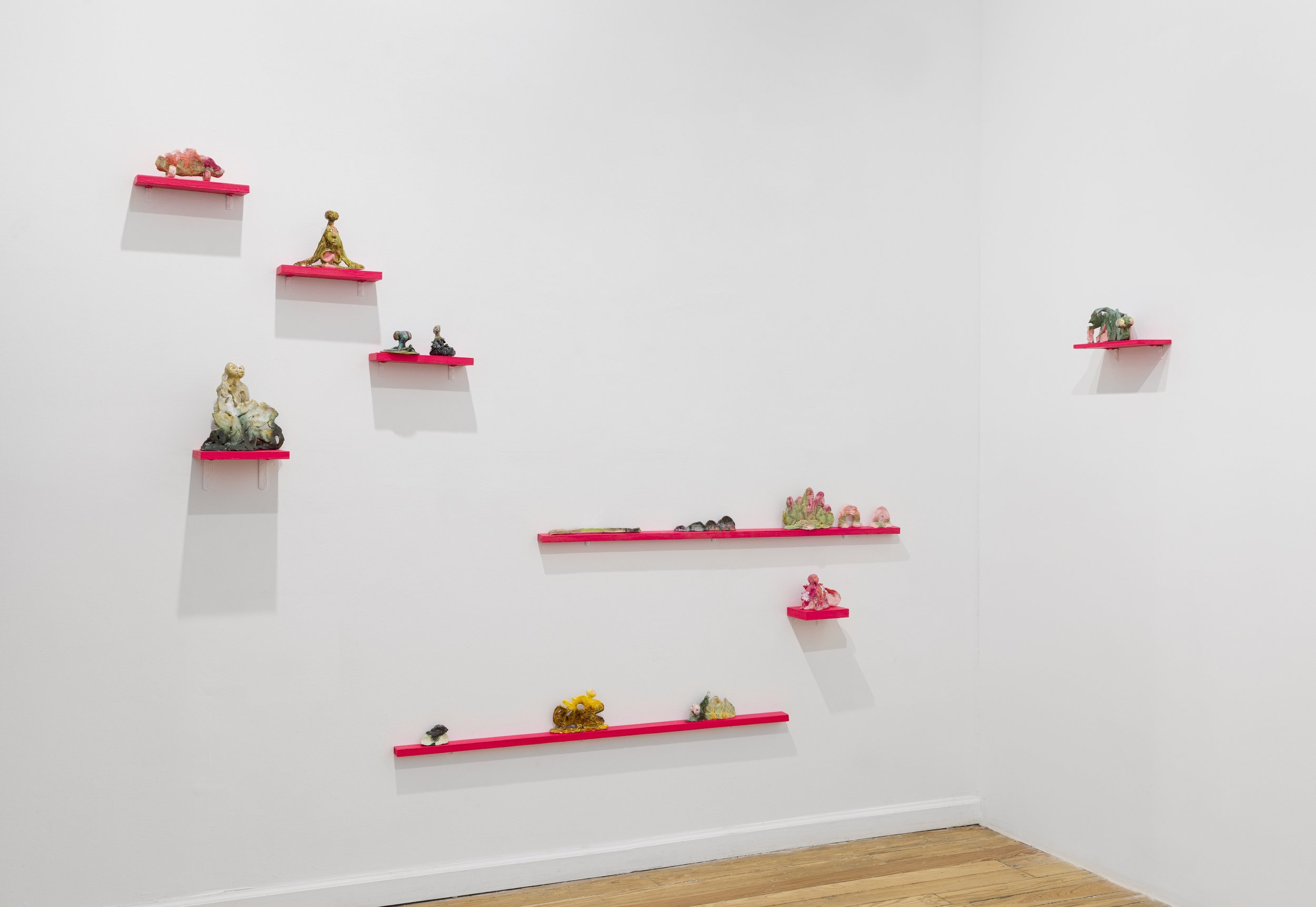
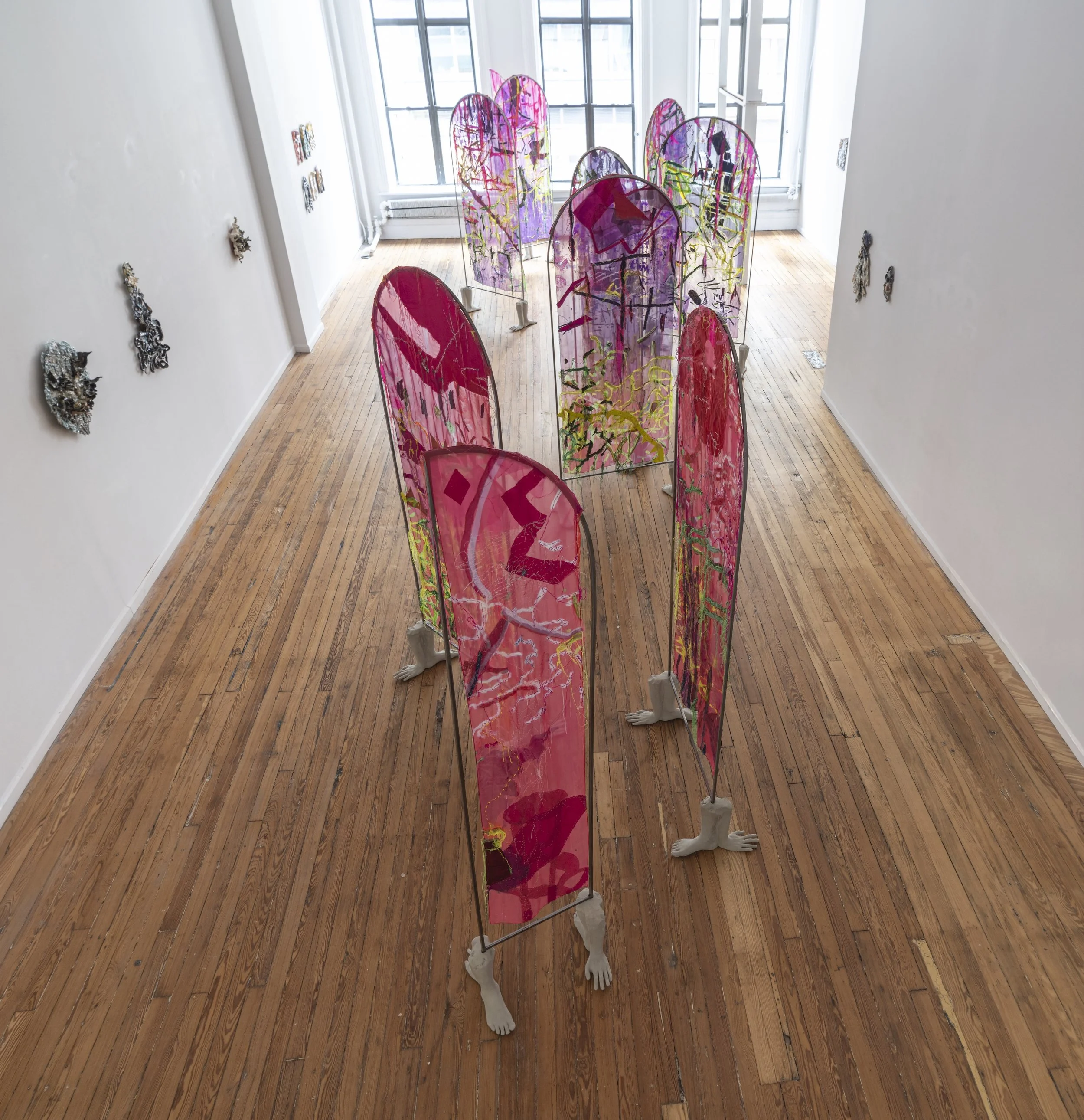
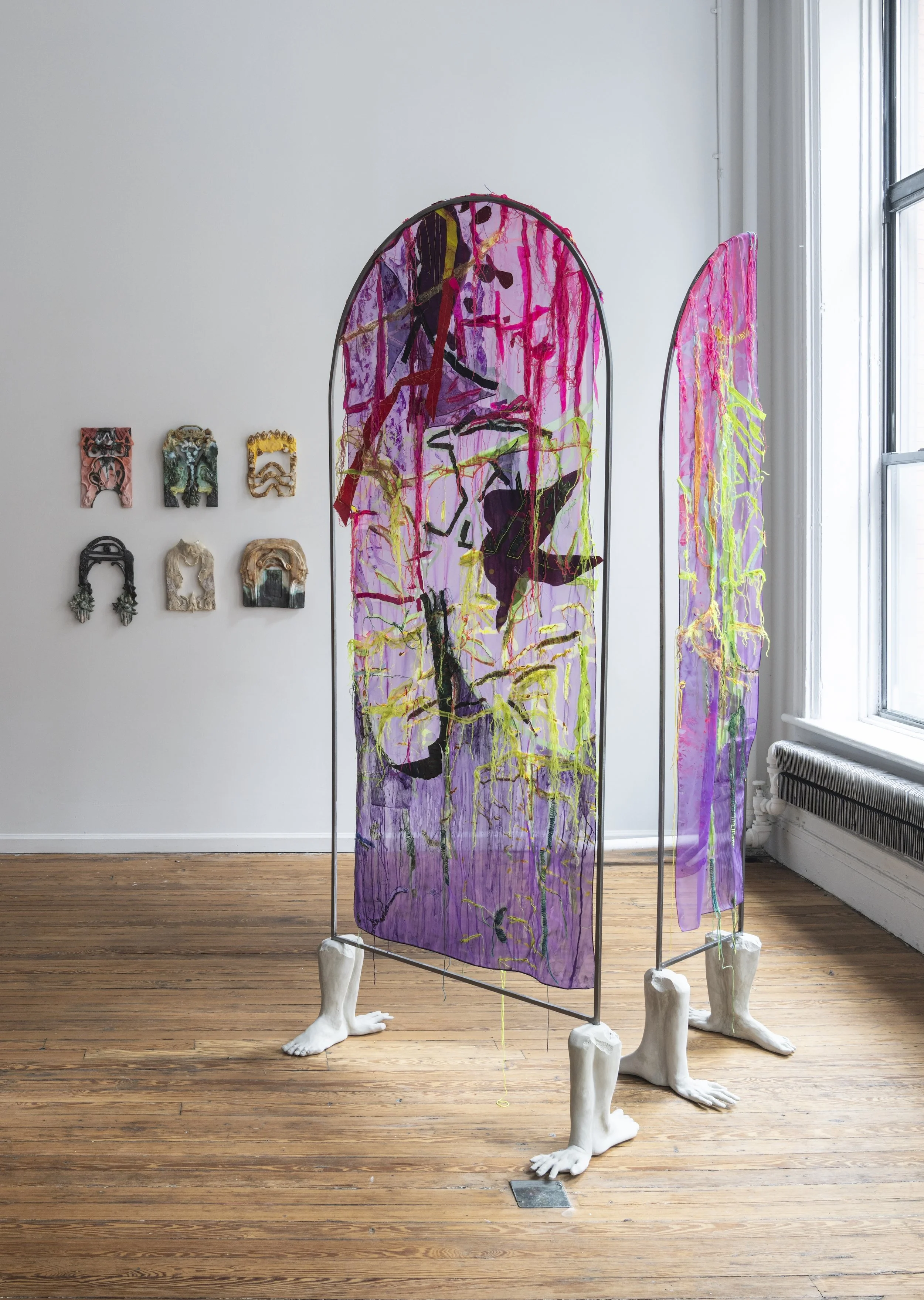
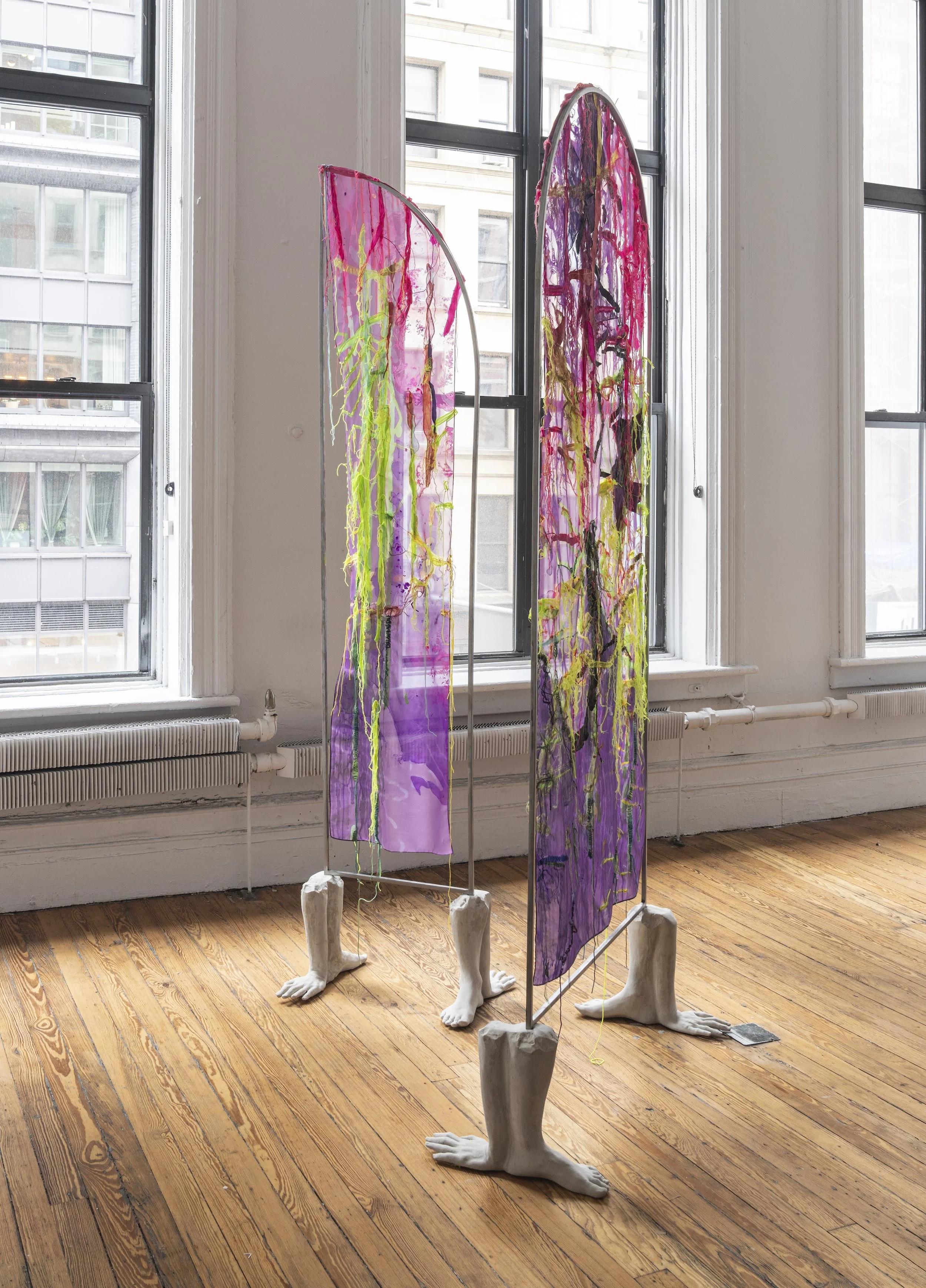
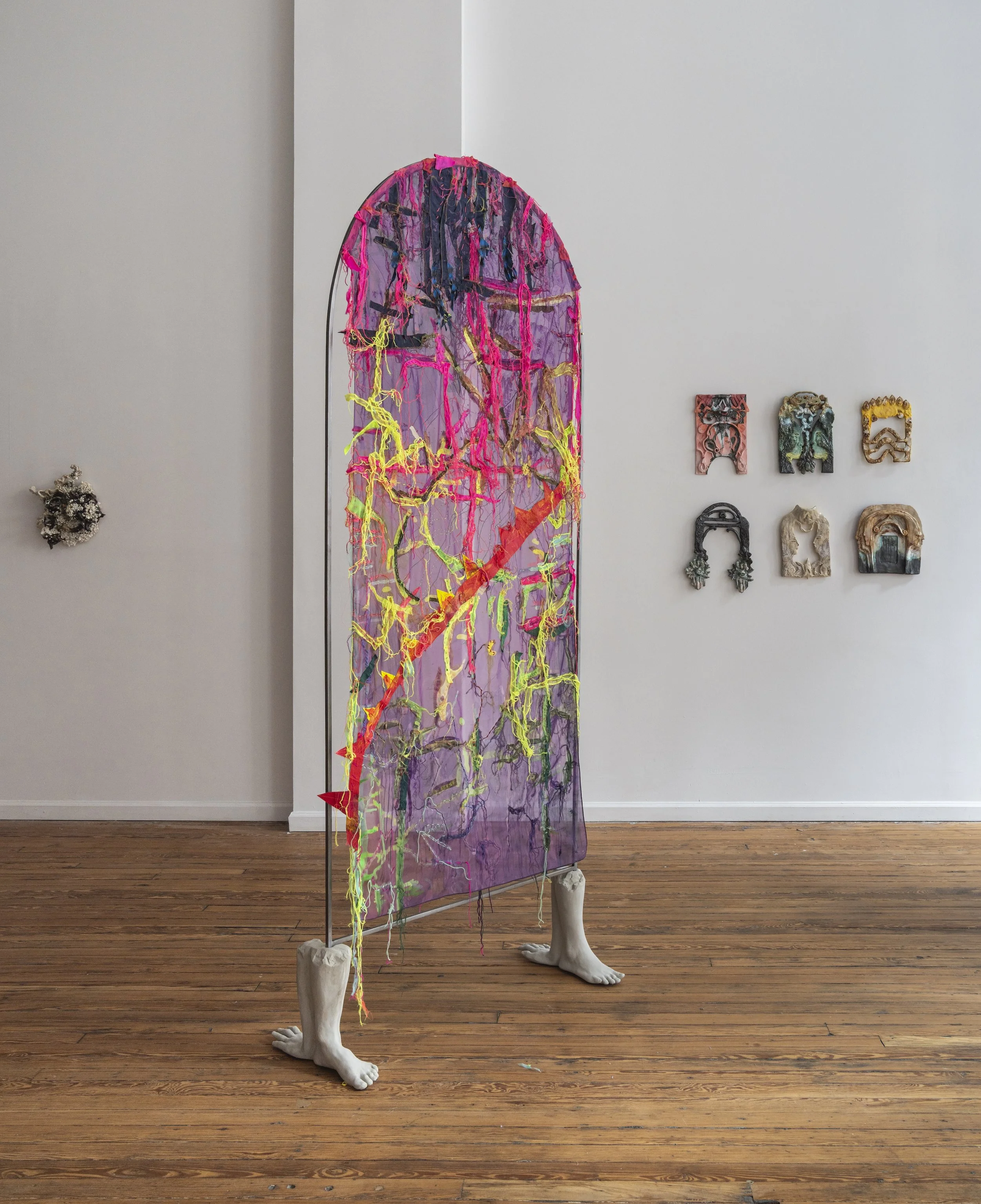
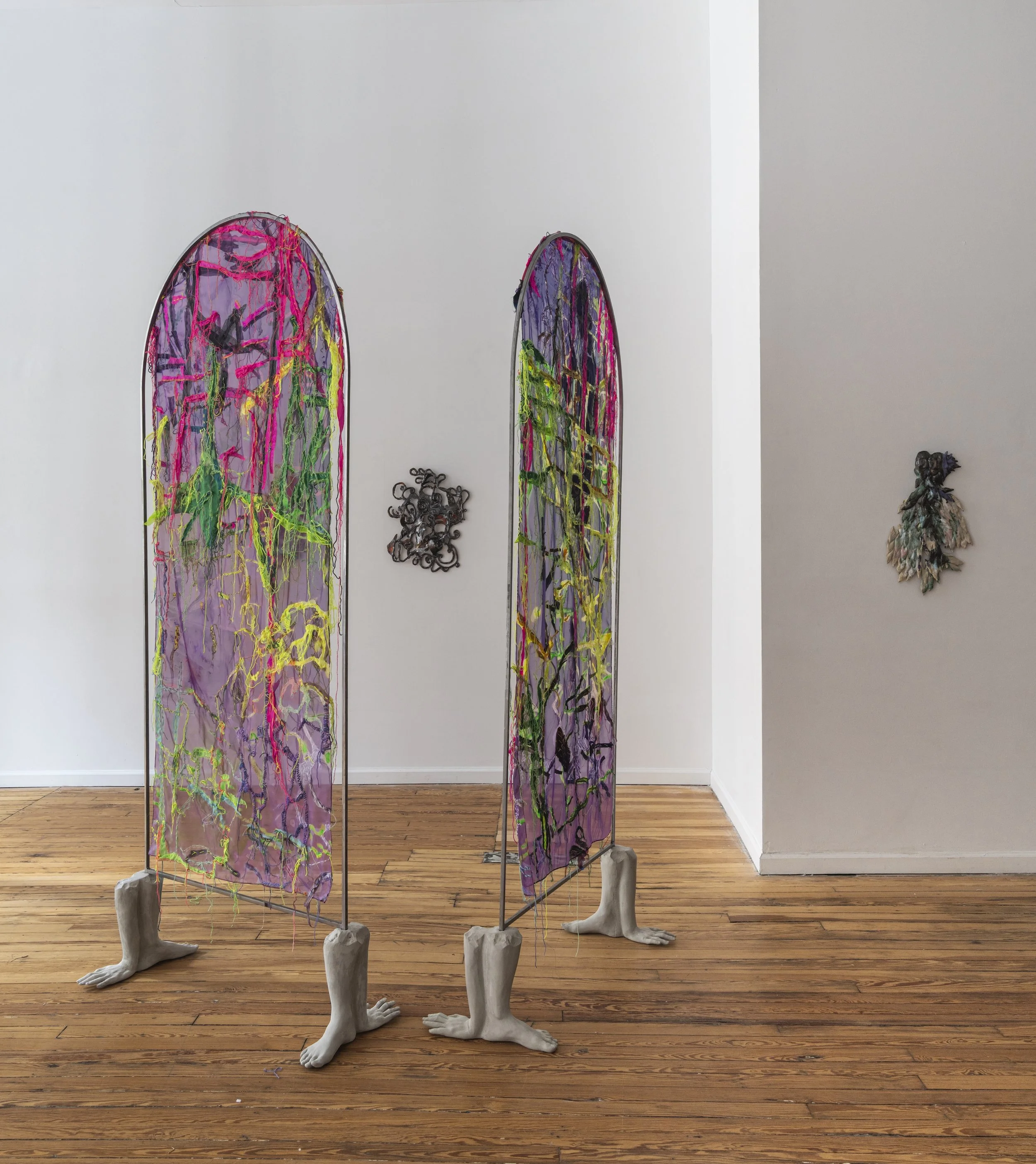

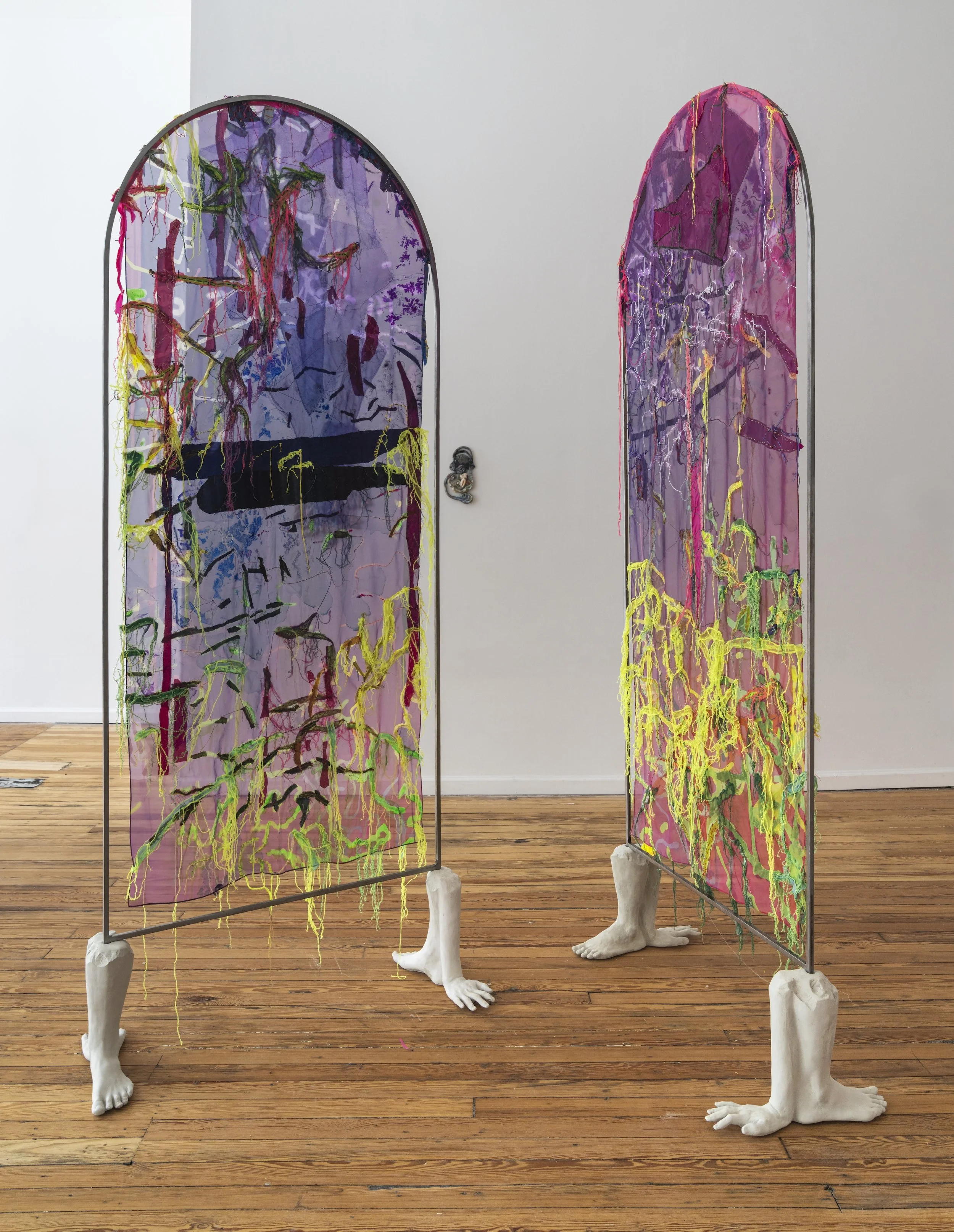


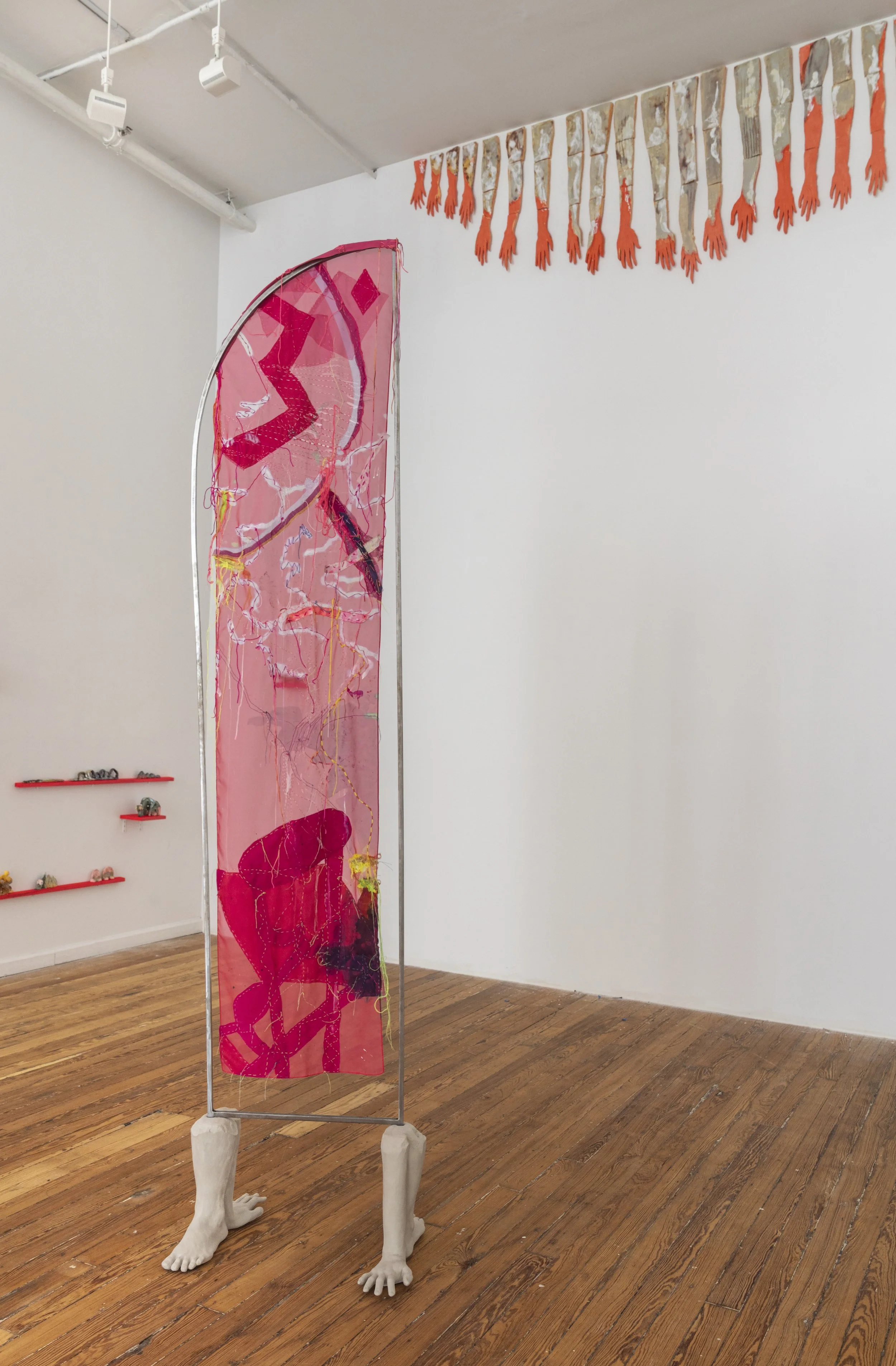
Allegory of Continents, 2025, Textiles, yarn, paint, steel, concrete, ceramic, 40 x 20 x 12 feet; Photos by Cary Whittier and Etienne Frossard.
(scroll down for description)
Allegory of Continents is a visual metaphor about movement, ancestry, and geography. The exhibition functions as a single installation in which all of the works are interconnected, referencing visual cultures from my ancestral countries of origin, particularly the Philippines and the ancient UK. Across the space, I am interested in how bodies, landscapes, and architectures evolve together through migration, time, and exchange.
The form of the biombo is central to this installation. A Mexican folding screen used to divide space, the biombo came to Central America from Japan and the Philippines via the Spanish Empire’s Manila Galleon trade. The word biombo is a hispanicization of the Japanese word byōbu. I am interested in the double-sided object as a site where space and time expand and contract, as well as the geopolitical and cross-cultural nuances that led to the biombos' existence.
Allegory of Continents (1–10), a 10-part sculpture extending across space, is the main artwork inspired by the biombo. This work consists of 10 steel arches suspending hand-sewn and painted textiles, anchored in concrete casts of my hands and feet. The textiles depict a reimagined map I invented, one that collapses borders and blurs spaces. The sewn marks reference earth, sky, ocean and body rhythms, movements, and patterns. For example, some of the sewn lines refer to aerial views of the topography of the UK, while others reference constellations used by ancient Filipino wayfarers. Some of the stitches reference the heartbeats of me and my daughter, while others reference decorative patterns from pre-colonial pottery.
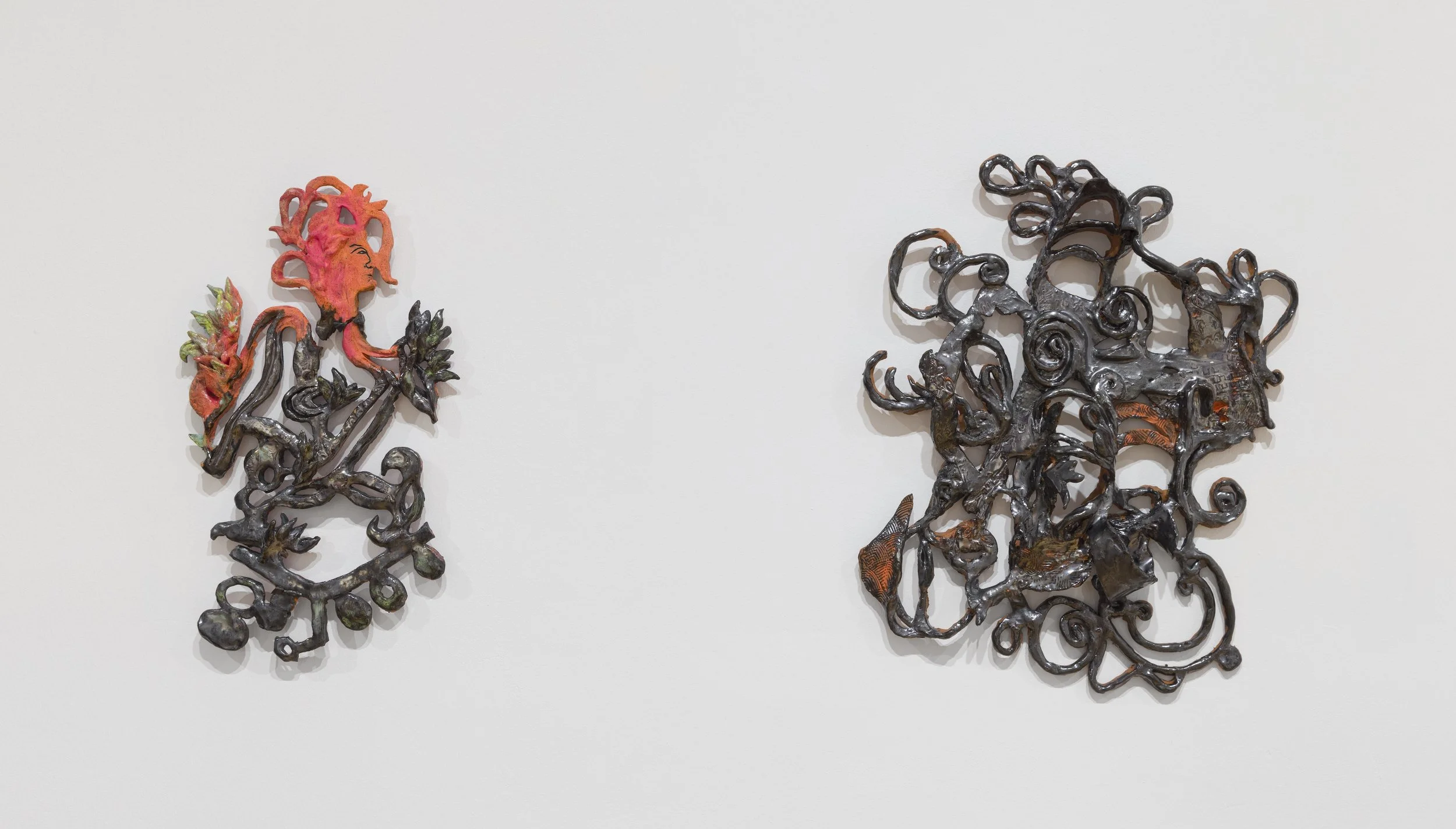
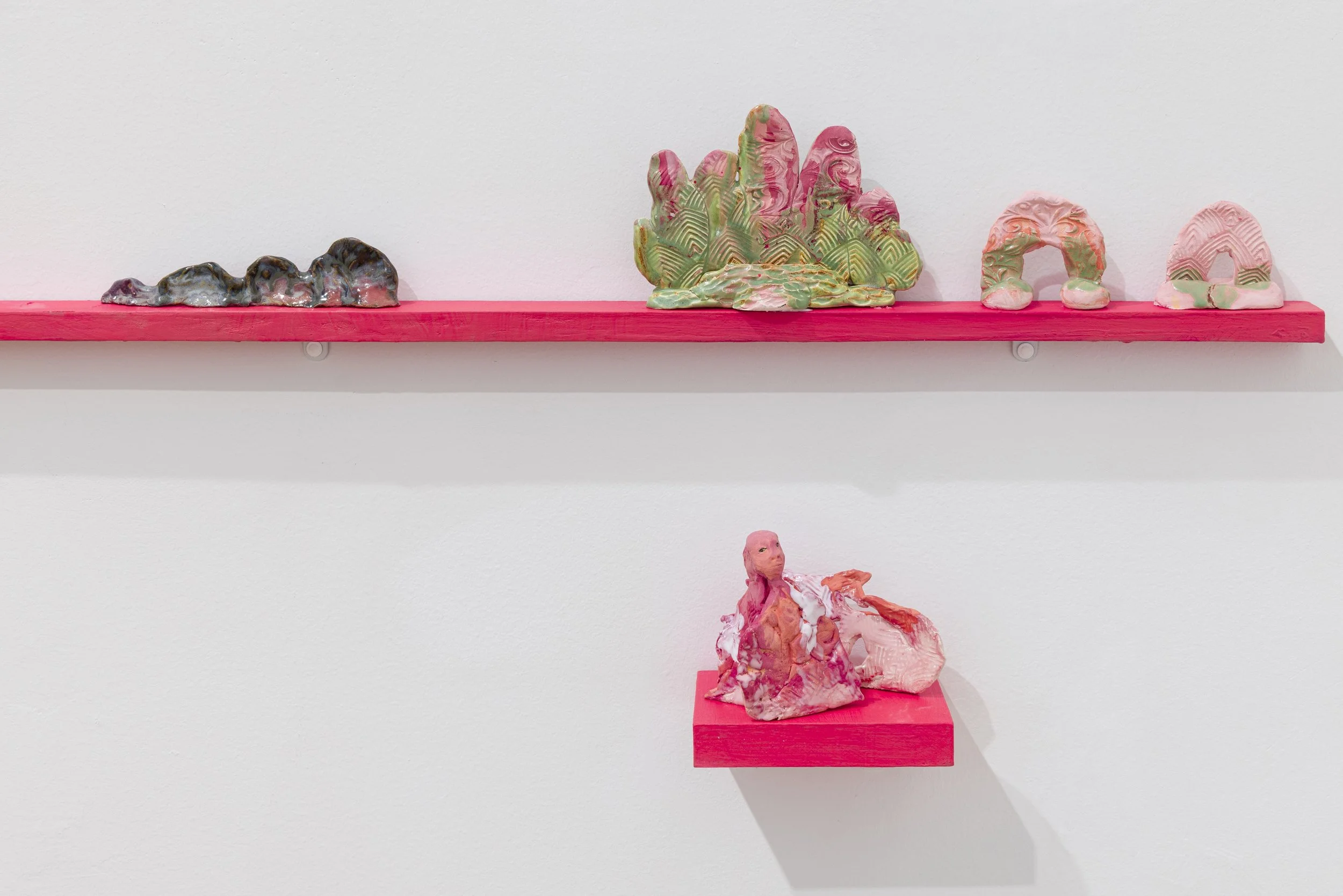
The ceramic works on the walls of the exhibition continue to expand on these ideas. I think of the ceramics as shape-shifting bodies that merge human, plant, animal, landscape, and architectural elements. Drawing from pre-colonial Filipino and pre-Roman UK sources—including ceremonial sites, pottery, jewelry, monuments, maps, and ornamentation—I collage fragments of these visual cultures into new forms.
All of the exhibition’s titles draw from Trinh T. Minh-ha’s Cinema Interval, reflecting my interest in the interval as a space of transformation—an opening where movement, memory, and multiplicity can coexist.
Photos by Etienne Frossard and Cary Whittier